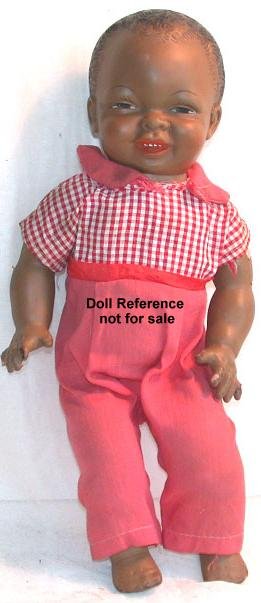
The Effanbee Doll Company* was founded by two businessmen who were first neighbors and friends in Atlantic City, New Jersey--Bernard E. Fleischaker and Hugo Baum. After forming their doll company, its trademark name became EFF (for the "F" in Fleischaker) and BEE (for Baum)--Effanbee. Their motto became, "Dolls that Touch Your Heart." Like Horsman dolls and a few other companies that will be mentioned in subsequent posts, Effanbee dolls incorporated dark skinned dolls into their lines shortly after the company's inception in 1912.

Initially this blog was to be devoted to Marilee (1924), pictured above, standing, with Sweetie Pie (1930s), but other early black dolls by Effanbee deserve recognition.

Snowball a.k.a. Black Grumpy and Patsykin/Patsy Jr. date back to years 1913 and 1930, respectively. Both are of composition construct; however, Snowball's composition is limited to the head. The body is cloth with red circular striped cloth legs (covered by the doll's pink polka dot romper). Patsy dolls were very popular during the first quarter of the 19th Century so much so that several other manufacturers made Patsy look-a-like dolls, mostly in white, but black Patsy look-a-likes can still be found today. Effanbee has produced several modern versions of black Patsy dolls as well.

Marilee and Sweetie Pie are less common finds than the well-documented Black Grumpy and black Patsy dolls by Effanbee. Both dolls were eBay finds. Marilee was a basket case. She arrived as an incomplete restoration without pupils. It is uncertain if her lamb's wool wig is original or if black Marilees had a different style wig. The white ones did. I completed the restoration, intentionally giving her fuller lips, and I added synthetic, brown pupils, which replace the doll's original brown, tin pupils. She was my first composition restoration.
Sweetie Pie was described by the seller as having been stored in an attic along with her white counterpart. The white doll was in extreme preloved condition while Sweetie Pie was near mint. My best guess is the prior owner of the two dolls played with the white version more. After her doll-play years concluded, the dolls were stored together, possibly along with others, in the attic of her childhood home. The dolls were later sold together at an estate sale with the eventual auction of my doll on eBay. I recall there being a bidding war at the end of the auction, but I was determined to win Sweetie Pie.
*The Effanbee Doll Company is now owned by Robert Tonner and maintains the original motto: "Dolls that Touch Your Heart."

Initially this blog was to be devoted to Marilee (1924), pictured above, standing, with Sweetie Pie (1930s), but other early black dolls by Effanbee deserve recognition.

Snowball a.k.a. Black Grumpy and Patsykin/Patsy Jr. date back to years 1913 and 1930, respectively. Both are of composition construct; however, Snowball's composition is limited to the head. The body is cloth with red circular striped cloth legs (covered by the doll's pink polka dot romper). Patsy dolls were very popular during the first quarter of the 19th Century so much so that several other manufacturers made Patsy look-a-like dolls, mostly in white, but black Patsy look-a-likes can still be found today. Effanbee has produced several modern versions of black Patsy dolls as well.
Marilee and Sweetie Pie are less common finds than the well-documented Black Grumpy and black Patsy dolls by Effanbee. Both dolls were eBay finds. Marilee was a basket case. She arrived as an incomplete restoration without pupils. It is uncertain if her lamb's wool wig is original or if black Marilees had a different style wig. The white ones did. I completed the restoration, intentionally giving her fuller lips, and I added synthetic, brown pupils, which replace the doll's original brown, tin pupils. She was my first composition restoration.
Sweetie Pie was described by the seller as having been stored in an attic along with her white counterpart. The white doll was in extreme preloved condition while Sweetie Pie was near mint. My best guess is the prior owner of the two dolls played with the white version more. After her doll-play years concluded, the dolls were stored together, possibly along with others, in the attic of her childhood home. The dolls were later sold together at an estate sale with the eventual auction of my doll on eBay. I recall there being a bidding war at the end of the auction, but I was determined to win Sweetie Pie.
*The Effanbee Doll Company is now owned by Robert Tonner and maintains the original motto: "Dolls that Touch Your Heart."