
 |
| Black Ideal Crissy Family, L-R: Beautiful Crissy, Tressy, Velvet, Tara, Cinnamon |
In 2009, I wrote an article, entitled "Ideal's Black Crissy Family," which was published in the December 2009, Issue 22 of Doll Showcase Magazine. Recently, after rephotographing some of my Crissy and family dolls, I realized I had not blogged much about them. This post serves to rectify this and will include excerpts from the aforementioned article (actually almost all of it) with a few minor additions.
The Crissy grow-hair family is one of my favorite mod-era
doll collections. They include Beautiful
Crissy, Tressy, Velvet, Tara and Cinnamon (shown above in the first photo).
Crissy and Tressy are 18in/46cm while Velvet and Tara are
15-1/2in/39cm. Cinnamon, the cutest (in my opinion) and smallest family member, is 12in/30.5cm.
Each doll has a center grow-hair mechanism, which is activated by
twisting a knob or pulling a string in its back to shorten its center ponytail
and depressing a button on its stomach to lengthen it. A few years after my adult doll search commenced, I
was fortunate to find mint or near mint Crissy family dolls dressed in their
original or authentic extra fashions.
Ideal made several versions of the Crissy doll. These include:
- 1969 Beautiful Crissy with hair that grows to the floor, also referred to as “Hair-to-Floor” Crissy, wears an apple green lace dress with matching panties and apple green shoes.
- 1970 Beautiful Crissy wears the 1969 outfit but her hair only grows to just below her bottom.
- 1971 Movin' Groovin' Crissy has a swivel waist and wears an orange midi-length dress with brown and orange rope belt, orange panties made of the same fabric as the dress, orange boots with mock laces.
- 1972 Look Around Crissy wears a long green plaid taffeta dress, matching panties, and green shoes. Appropriately named, when her pull string is extended, she turns from side to side and “looks around.”
- 1973 Swirla Curla Crissy is dressed in an orange and white plaid dress, white panties, and orange Mary Jane shoes.
- 1974 Twirly Beads Crissy wears a pink gingham, full-length dress, white panties, and white Mary Jane shoes.
- 1977 Magic Hair Crissy has Velcro hair attachments instead of a grow-hair mechanism. Her original outfit is a white camisole, pink sateen skirt, and white mules.
- 1982 Country Fashion Crissy, at 15 inches tall, shrank 3 inches and her face changed! Perhaps in an attempt to exhaust remaining quantities, Ideal used the Velvet face mold and body for this Crissy. The doll wears a pink gingham dress, white socks and shoes, and straw hat. Instead of a tummy button and knob, the grow hair operates with a pull string.
- 1982-1983 Beautiful Crissy returned with the Velvet face and body dressed in a white, lace-trimmed dress and white shoes. Unlike Velvet, this Crissy has brown eyes with pupils.
- 1983 Country Fashion Crissy reappeared wearing a lavender gingham dress, straw hat, white socks and shoes. The Velvet face and body molds were used once again, but the brown vinyl complexion noticeably darkened.
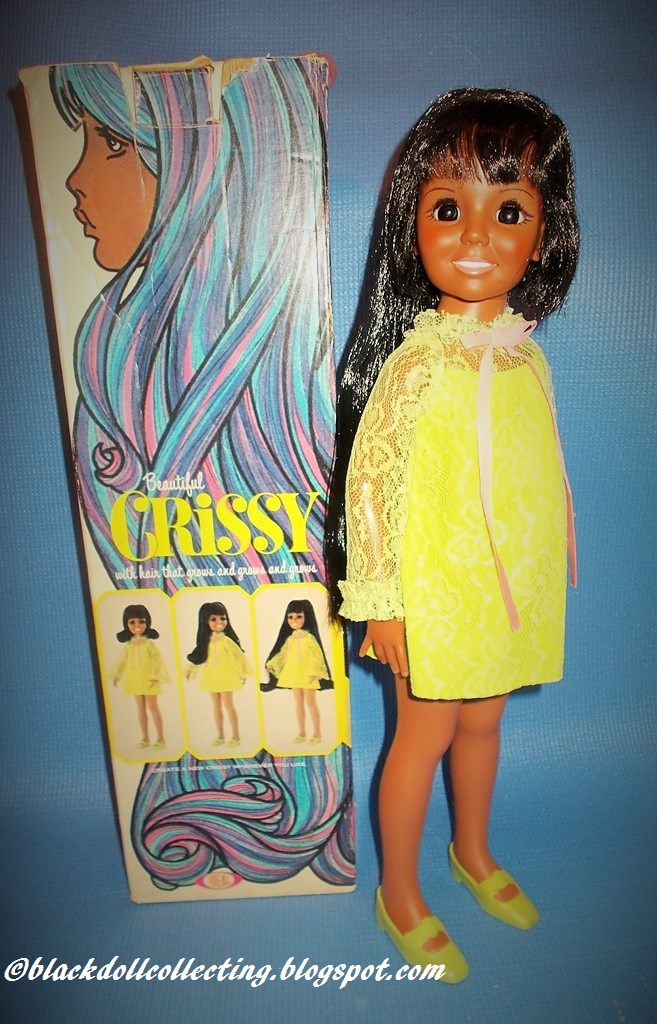 |
| 1969 Beautiful Crissy with hair that extends to her bottom (this one is not the hair-to-floor version.) |
 |
| 1971 Movin' Groovin' Crissy is shown with another Crissy doll that wears the White doll's orange lace dress and orange shoes. |
 |
| These are two preloved Crissy dolls purchased prior to finding the NRFB Beautiful Crissy. The one on the left wears a Look-Around Crissy dress with blue Crissy shoes. The doll on the right wears a handmade off-white dress with attached lace apron. |
 |
| Magic Hair Crissy is not a true grow-hair doll; as indicated previously, she has hair pieces that attach with Velcro. |
 |
| Magic Hair Crissy in original box is for sale on Etsy, in case anyone is interested. |
 |
| Tressy, on left, wears Swirla Curla Crissy's dress with white shoes. Tressy, on right, wears her original dress, a replica of her original headband, and black shoes. |
While Crissy has black pupil-less eyes, Tressy's eyes are brown with visible black pupils as illustrated in the next head shot photo of Crissy and Tressy.
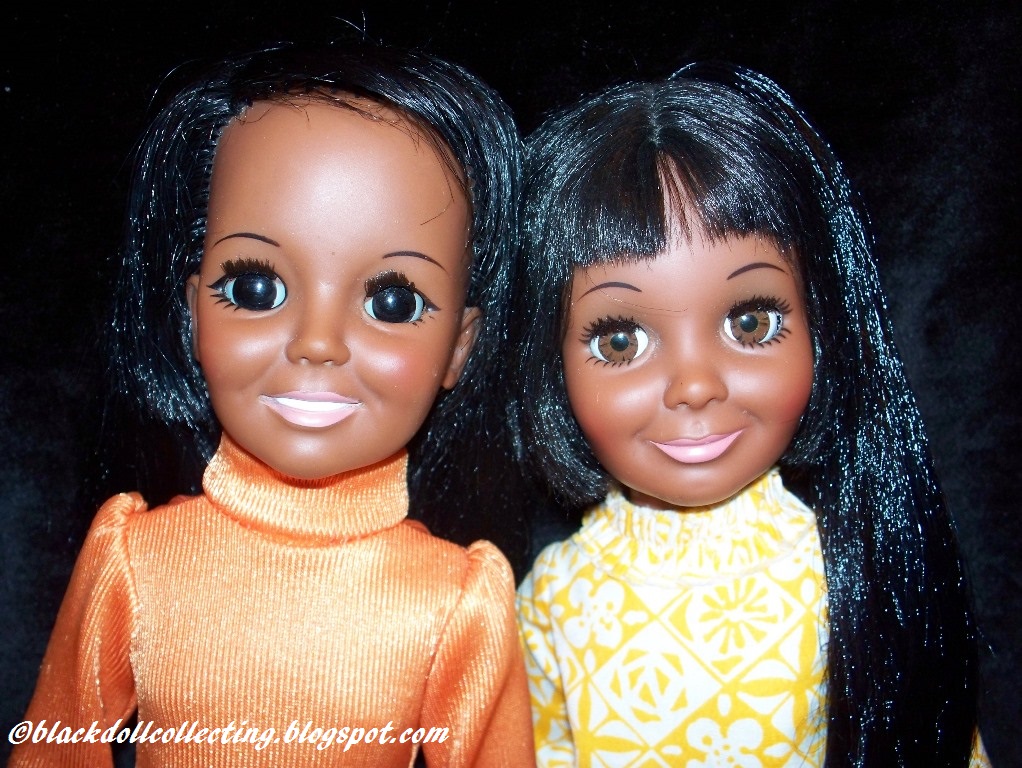 |
| Crissy and Tressy eye comparison |
Black Velvet, Crissy's cousin, debuted in 1970 wearing a lavender dress and lavender shoes. The doll is often found wearing the White version’s purple corduroy dress.
 |
| Velvet wears a replica of her original lavender corduroy dress with original white lace-up mules. Velvet on the right wears the Ideal tagged fashion, Ruffled Up. |
There were several versions of Black
Velvet. The first two dolls mentioned
below, have the same functionality as the Crissy dolls of the same name.
- 1971 Movin' Groovin’ Velvet wears a pink party dress, matching panties and purple shoes.
- 1972 Look Around Velvet is dressed in a plaid taffeta dress similar to Look Around Crissy’s dress, matching panties, and white shoes.
- 1973 Beauty Braider Velvet wears a pale lavender dress with matching velvet sash, matching panties, and lavender shoes.
- 1974 Swirly Daisies Velvet’s attire consists of a purple/lavender/pink/white plaid dress with white bodice, matching panties, and lavender shoes.
- 1981 Velvet, the final issue, wears a white lace-trimmed dress with pink ribbon at waist and white shoes. This doll has a pull string instead of a belly button and knob.
 |
| Scan of page 148, Definitive Guide to Collecting Black Dolls |
In 1976 Tara, promoted as “The Authentic Black Doll with Hair That Grows!” made her debut. Tara is the only doll in the Ideal grow-hair family that did not share a face mold with any other member, Black or White. Her facial features were described as “authentic” or ethnically correct.
Tara wears a yellow gingham
pants set and yellow shoes. One side of
her colorful box features a beautiful African-American girl holding a Tara
doll. It is reported that some
collectors do not consider Tara an “authentic” Ideal Crissy family member,
while others feel her grow-hair mechanism and size give her Crissy family
rights. Family member or not, Tara ranks
as one of the most difficult Black grow-hair dolls to find. Because of her rarity, a mint condition doll
usually commands top dollar, even in a sluggish economy.
 |
| 1976 Tara with original box |
 |
| 1973 Cinnamon, Velvet's little sister |
Cinnamon, Velvet's little sister, debuted in 1973, a year
after the White doll’s debut. Her
original outfit is an orange polka-dot short set with a white lace-trimmed
collar and orange shoes. In 1974, Curly
Ribbons Cinnamon joined the family. This
doll wears the same outfit from the prior year and has an extra denim short
coverall with yellow gingham blouse.
Black Cinnamon is also an elusive Crissy family member, which inflates her value.
 |
| My all-original Cinnamon is redressed in this photo in peach overalls, peach headband with orange knit top and orange knit shoulder bag with chain shoulder strap. She wears her original shoes. The doll on the right wears a cute homemade overall fashion with yellow shoes. Cinnamon has painted eyes whereas all other Black Crissy family members have stationary, acrylic eyes. |
 |
| Baby Crissy, the original 1973 doll and the reissued 1981 version |
Baby Crissy, while not as popular as the other girls, is
also a member of the Crissy grow-hair family.
She made her debut in 1973 and resurfaced in 1981. Except for the clothing and slight difference
in vinyl color and texture, it is difficult to tell the two versions
apart. They are both 24in/61cm. The original doll wears a mauve, two-piece,
baby-doll outfit; the latter version wears a white romper trimmed in either
green or yellow gingham. The 1973
version has reddish brown vinyl which has a rubber-type consistency. The 1981 doll’s firmer vinyl does not have
the red tinge.
While I own both versions of Baby Crissy, my favorites
remain the core family members: Black
Crissy, Tressy, Velvet, Tara, and Cinnamon.
These mod dolls and their psychedelic colored fashions mimic fashions
from my youth (dresses and skirts with lengths from one extreme to the other,
bell-bottom pants, lace-up clogs, mules, floral and bold patterned fabrics, and
other hippie-style attire). They are
reminiscent of a period in my life when dolls and doll play were a long
forgotten pastime… when happiness, independence, and entering adulthood were my
main objectives. Now that I am a rather
happy, independent, adult, dolls are my favorite diversion from adult
responsibilities.
dbg
Check out my eBay listings here.


