|
| 16-inch Sasha doll with dark skin, brown eyes, and red hair by Sasha Morgenthaler |
No this doll was not made in Canada. She was most likely made by
Trendon Ltd., Stockport England. Doll artist and Facebook friend, Frantz Brent-Harris, creator of
Sonadolls, found the above preloved Sasha at a flea market in Canada. He offered her to the first taker for his cost plus shipping. My new doll arrived the Saturday before Mother's Day as shown above.
I washed and rolled her hair, then treated a stain that I discovered on the side of her right leg. See the following pictures for these details:
 |
| Sasha's auburn hair has been washed. |
 |
| She sat still while her hair was sectioned and rolled. I left the rods in until dressing took place some two weeks later. |
.JPG) |
| Leg stain prior to Oxy-10 treatment. The stain was faint, but I wanted to treat it. |
 |
| Oxy-10 was applied and left on the stain for 7 days. |
 |
| After 7 days, the leg stain faded some. I applied additional Oxy-10 for another week. More fading took place. The stain is still visible but not enough to cause worry. |
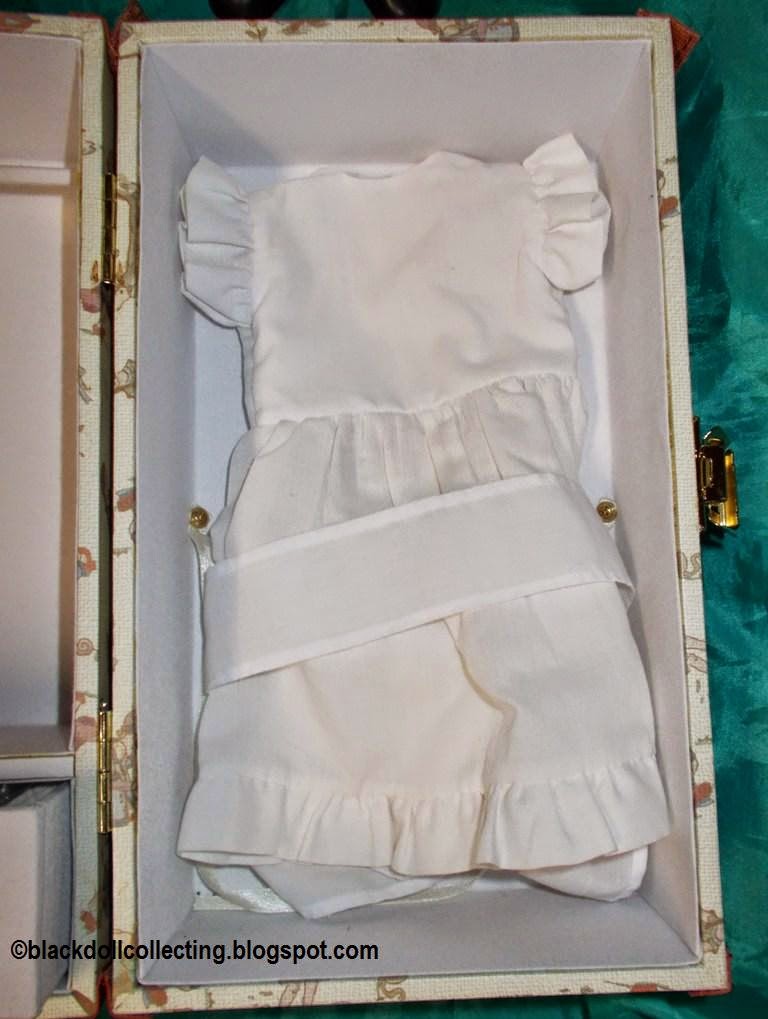
During Sasha's leg stain treatment, she remained nude. At the end of treatment, I dressed her in the perfect dress, tights (that cover the leg imperfection), and shoes that were all on hand.
Sasha shows off her lovely locks that were finger-combed.
Wearing the bolero jacket that matches the dress, Sasha has joined Sasha #108 who has been here since the summer of 2011. The older doll arrived with her original white dress, which I cannot locate at present. The two are now BFFs and display quite well together.
Shown below are Gotz babies Andrea (1996), a redhead; and brown-haired dolls Celina (1996), Christina (1997), and Toni (1999). Like the 16- and 17-inch Sashas, the babies have dark caramel complexions.
Ebony complexioned Sasha dolls and two
brunettes with caramel complexions can be seen in
a previous post.
As a result of my new Sasha and
this post, I purchased the book,
Sasha Dolls:
The History by Anne Votaw, Ann Louise Chandler, and Susanna E. Lewis.
Sasha dolls are a type and series
of doll created by Swiss artist and dollmaker Sasha Morgenthaler (1893–1975),
produced in Germany and the United Kingdom beginning in the late 1960s. Popular
with collectors, Sasha dolls are characterized by their individualism, their
realistic expressions, their unique color, and the extreme attention to detail
in the manufacture of the dolls as well as their clothes. It is said by
Juliette Peers that: "Sasha dolls are renowned for possessing a solid
intellectuality, despite their bizarre origins as representations of holocaust
victims."[1] Morganthaler created face sculpts for her dolls with subtle
expressions to not dictate artificially exaggerated smiles, her concern that
children surviving the horrors of WWII would not relate to dolls so happy in
times of terror. Morganthaler, herself, "When she was sad, she did not
like her dolls uncompromising smiles. Once she grabbed a nail file and scraped
off her doll's false grin..." In her own words, "No grotesque
caricature can awaken a child's true feelings. A piece of wood, barely carved,
is far superior to a conventional doll with an exaggerated smile."[2] Read more.
__________
1. Mitchell & Reid-Walsh
(2008). Girl Culture: An encyclopedia. p. 29.
2. Votaw & Chandler
& Lewis (2011). Sasha Dolls, The History. p. 10.
dbg