|
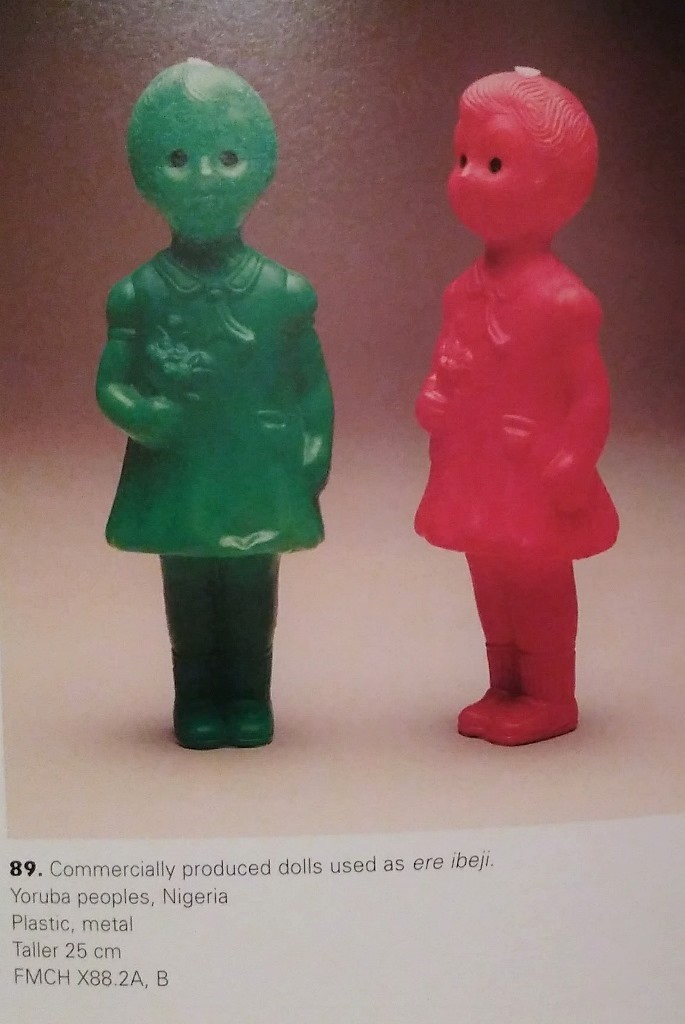
| The six colorful dolls shown above are Clonette dolls or baby DeiDei (day-day) dolls. |
Recently, I communicated on Instagram with an artist from Israel who crafts ceramic figures that are inspired by Clonettes and other vintage dolls. She shared pictures of her creations and we discussed her style, which I will describe later in this post. During our communication, I shared that I wanted brown and black Clonettes after which she provided a link to Clonette Dolls' website. I was familiar with this England-based site and had considered purchasing from them before. The shipping from England was a deterrent. Now, over three years later, I decided to bite the bullet and order the two desired colors since the price of each Clonette was reasonable. Clonette Dolls has an Etsy site and a website. I ordered from their Etsy store because the total price of the dolls plus shipping was slightly less.
 |
| My brown and black Clonette Dolls arrived wearing a Clonette Dolls tag around their necks. |
The dolls arrived in good order. I was surprised at their height of 9-1/2 inches. They are a full inch and a half taller than the original six as illustrated next.
 |
| The yellow Clonette, purchased from Treehouse Kid and Craft, is 8 inches tall while the brown and black Clonettes are 9-1/2 inches tall. |
Like the smaller version, the brown and black dolls are constructed of thin, molded plastic with molded-on clothing, socks, and shoes. They each hold a rabbit with their right arm and each makes a squeaking sound when pressed.
As quoted in my original post on Clonette Dolls, "These sweet plastic dollies, known as Clonette dolls, or baby DeiDei dolls, are a significant part of African history and have become quite the collector's item! Modeled after colorful traditional wooden and grass dolls, these little girls were the first industrially produced doll in Africa and have been made from recycled plastics in Ghana since the 1950's. Often given as a gift to expectant mothers, Clonette Dolls are said to be a totem of good luck and act as a guardian for babies and children. Their retro look and pop art colors have made them popular the world over. When squeezed, baby DeiDei makes a squeaking sound, adding yet another element of charm to this already-fascinating doll." [https://treehousekidandcraft.com/products/deidei-doll?variant=14709626116] Read more about the history of these dolls and my independent research at the related link, Baby DeiDei Clonette x 6, below.
The above description of Clonette dolls does not provide the original use of these now commerically-produced Ghanaian-derived dolls. There is a high incidence of twin births among Yoruba women with the unfortunate death often of one twin. Clonettes have been used as an ere ibeji to memorialize a deceased twin. Original ere ibeji were male or female figures carved of wood or made of glass. The Yoruba women would care for the figure as though it were a real baby. Commercially-produced Clonettes have also been used for this purpose.
 |
| All my Clonette dolls posed together in this photograph. |
Fugi Naim
 |
| This is a colorful display of black ceramic figures by ceramic artist, Fugi Naim. |
Ceramic artist, Fugi Naim, resides in Israel where she makes mostly ceramic dolls in her studio. She shared that she makes her figures with "great love" and deliberately chooses to use the colors for her black figures "since they are identified or correspond with other works done in the past." Made with positive intent, her motive is to continue the discussion with her reinterpretations of vintage dolls.
As a result of my online conversion with the artist, she graciously sent one of her ceramic vintage doll creations to me.
 |
| This 8-1/2-inch mauve-cheeked ceramic girl by Fugi Naim has two sculpted Afro puffs, mauve eyeshadow and lip color. |
 |
| She is a modern interpretation of Clonette dolls. |
Fugi Naim was inspired by Clonette dolls to create this sweet approximately 8-1/2-inch ceramic figure. Like Clonettes, the clothing is molded on and the figure cradles a white rabbit.
 |
| This is a close-up image of the white rabbit and the figure's colorful dress, socks, and shoes. |
Unlike Clonette dolls, Fugi Naim's figure has colorful facial accents and brightly colored clothes. The bodice of this particular one's dress is painted red and white polka dot. The base color of the skirt is white with red and black diagonal lines and inverted V-shapes that create a pattern throughout. Red and white striped painted-on stockings and shiny gold metallic shoes complete the painted attire. The figure stands on a white ceramic base. The bottom of the base is padded with a protective shimmery gray felt round.
The following additional photos further illustrate Fugi Naim's Clonette interpretation.
 |
| The figure is illustrated from a full-length partial side-angled view. |
 |
| In this close-up partial side angle, the sculpted Afro puff is better illustrated. |
 |
| The figure is signed on the back "Fugi Naim" with a "pulsating" heart shape drawn underneath. |
 |
| The black and brown Clonettes pose with the Fugi Naim-interpreted figure. |
Thanks to Fugi Naim's suggestion, I have now crossed brown and black Clonettes off my short want list and I own one of her beautiful Clonette interpretations that arrived with a Jerusalem, Israel postmark.
Thank you, Fugi Naim, for enhancing my collection with your art.
Related Links
dbg
There are countless items to collect and write about. Black dolls chose me.
__________
Thank you for reading. To contact me, please use the contact form on the right of the home page, which is visible in "web view." A link to web viewing should be visible at the bottom of this page.
Check out what I am selling here.
Check out my eBay listings here.
Please follow my sister blog Ebony-Essence of Dolls in Black.
Donate here to support this blog. Thank you!
There are countless items to collect and write about. Black dolls chose me.
Thank you for reading. To contact me, please use the contact form on the right of the home page, which is visible in "web view." A link to web viewing should be visible at the bottom of this page.
Check out what I am selling here.
Check out my eBay listings here.
Please follow my sister blog Ebony-Essence of Dolls in Black.
Donate here to support this blog. Thank you!