Showing posts with label Ideal. Show all posts

Monday, June 2, 2014

Childhood Dolls from the Past

Dolls by Ideal Toy Corp, 1968-1971

This post began with a desire to photograph two dolls by Mattel.  During the process, I reacquainted myself with several dolls that were major hits for children during the late-1960s through the early-1980s.  Their manufacturers – Ideal, Mattel, and Remco – were quite competitive during this 20-year time span with Ideal and Mattel taking the lead in sales.  My collection consists of several other dolls by these manufacturers and others (EEGEE, Horsman, Kenner, Shindana, to name a few) that are not shown or discussed in this post.  The ones shown “chose” to be featured and discussed at this time.   (They all needed a good dusting and I am sure are still thanking me for it!)

Ideal
Lazy Dazy by Ideal, 1971
Lazy Dazy ©1971 is a 13-inch vinyl and cloth doll with dark brown sleep eyes.  She has a two-piece canister-type body.  The doll can sit, but with the slightest movement, she tilts over as though she is falling to sleep.  Lazy Dazy wears her original floral print pinafore over her peach flannel body. She is missing her matching floral print pillow. 

Me So Glad, Belly Button Baby by Ideal, 1970
 
Me So Glad, Belly Button Baby, ©1970, is a 9-inch all vinyl baby with soft vinyl head, arms, and legs.  When her belly button is pressed, her head, arms, and legs wobble about as though she is extremely excited.  The doll has black rooted hair and brown painted eyes.

Newborn Thumbelina, Ideal, 1968
Newborn Thumbelina, 9 inches, has brown straight rooted hair with a side part and brown painted eyes.  The pull string in back activates her wiggle-like-a-baby movement.   She wears her original white top and orange knit pants with enclosed feet.  Newborn Thumbelina has a copyright date of 1967 and entered the market in 1968.

Mattel 
Dolls by Mattel, 1970-1982

Baby Beans, Mattel, 1970
 Baby Beans, ©1970 is 10-inches with vinyl head and hands and pellet-filled cloth body with sewn-on orange romper and matching hat.  Underneath the hat are black rooted bangs.  She has brown painted eyes and a wide smile.   

Baby Brother Tenderlove, Mattel, 1976
Baby Brother Tenderlove is a 13-inch, anatomically correct drink and wet baby with vinyl head and one-piece soft vinyl body with brown curly rooted hair and painted brown eyes.  This doll made his doll market debut in 1976 and is Mattel’s first anatomically correct Black baby doll. Anatomically correct females were available, but the male was more controversial. 

Baby Skates, Mattel, 1982
Baby Skates is a 15-inch rigid vinyl wind-up doll that skates.  She has a soft vinyl face, rooted brown hair, and brown painted eyes.  She wears a pink and yellow skater’s outfit, yellow elbow and knee pads, and roller skates.  The copyright date for this skater that does not require batteries is 1982.
Baby Small Talk, Mattel, 1968-1969
Baby Small-Talk, is a 10-1/2-inch pull-string talker that was available from 1968-1969.  The doll has a vinyl head, arms, and legs and a rigid plastic body.  The rooted hair is brown as are her painted eyes.  The mouth is open with two upper and two lower teeth.   She wears her original aqua and white polka dot dress with daisy appliqués, white panties, and pink hair ribbon.  Baby Small-Talk says eight different “baby-talk” phrases.  Seven of these are:  “I love you.  Kiss baby.  I’m sleepy.  Go bye-bye.  Nite-Nite.  Play Patty Cake.  Baby Sleepy.” 

Hush Little Baby, Mattel, 1975
Hush Little Baby is a 15-inch battery-operated crying and moving doll, ©1975.  She probably entered the market in 1976.  The doll has vinyl head, arms, and legs, and a rigid vinyl body with battery compartment in back.  The brown hair is rooted and was originally curly.  Because of the poor condition of her hair upon arrival, I shampooed and conditioned it before styling in several braids held with ponytail holders and barrettes.  She wears her original pink and white short pants, white top with animal motif on front and pink and white trim at sleeves and collar.  Hush Little Baby has brown painted eyes.

Remco
Growing Sally, Remco, 1968
African American doll artist, Annuel McBurrows sculpted Growing Sally for Remco.  The doll has a box date of 1968, style #3295.  Sally is all vinyl with black yarn hair and painted facial features.  She is 6 inches before she grows a half inch taller.  There is a mechanism in the middle of her body that activates her growth.  An extra full-length dress and wig are included for her to wear after she grows.   


I love Growing Sally's facial features.

Discussed in another blog post, other dolls sculpted by Annuel McBurrows for Remco include:  Baby Know It All, Brown Eye Billy, and Winking Winnie.  These dolls are from the Brown Eye doll series.  Additional Brown Eye dolls along with a head shot of McBurrows can be seen here.

Singing Mimi was also a popular 20-inch fashion doll by Remco, 1973.  Mimi is not a McBurrows design. 

*****

As a child, did you own any of these; or did your children own any? 

dbg

Monday, August 19, 2013

Wild Wild Sunflower Child Anna

Anna by Alice Darling for Madame Alexander (click the pictures to enlarge).
Anna is from the 1990s "Let's Play Dolls series by Alice Darling (Robin Woods).  Designed for the Madame Alexander doll company, she is an all-vinyl, 13-inch doll with black wig styled in a curly side ponytail, which is accented by an over-sized bow of graduated colors.  Anna has brown painted eyes.  Her original floral print cotton dress is in pastel colors of yellow, mint green, pale pink, and light blue.  She wears white fishnet stockings and yellow Mary Jane shoes that have an embroidered basket with floral bouquet at the toe.

I purchased Anna at retail in approximately1994.  (The copyright date on her hang tag is 1993, so she probably entered the market a year later.)  I was very much into artist dolls then and purchased many newly released African American dolls with reckless abandoned.  Price was not an issue, well, mostly it wasn't because I had not yet established criteria for collecting and basically purchased what I liked, or what I thought I liked, and I liked and wanted Anna.

I still like her, but I grew to dislike her painted eyes.  They are not very realistic looking.  For years she has been on the top shelf at the back of the doll room collecting dust along with several similar dolls.

Earlier this month I received an email from fellow collector, Dawn Spears, with a link to an eBay auction for Anna.  Dawn asked if I owned the doll on auction that had been inspired by a book because she is familiar with my Dolls with Books exhibit.  My reply was, "I'll have to check."  I thought I probably owned the doll but the name "Anna" did not ring a bell.  I knew her artist, Robin Woods (aka Alice Darling) had made at least two dark-skinned dolls that use the same head and body sculpts as Anna, but I could not remember my doll's name.

Anna gazes at the book that inspired her creation.

The book, Wild Wild Sunflower Child Anna by Nancy White Carlstrom, illustrated by Jerry Pinkney, was first printed in 1987.  At the time I received the email regarding Anna and the book that inspired her creation, I did own the doll but not the book.  I had no idea Anna's creation had been inspired by this book and had to learn more about this.

I did not have to look too far for the confirmation I needed.  It was right on Anna's wrist hang tag in big bold letters, confirming that she is from the Read Me a Story series by Alice Darling.  According to Anna's hang tag, "The dolls of  'Read Me a Story' are inspired by children’s love for stories and by contemporary children’s books.  The dolls provide interpretations of story book characters who become friends to play with and love."

A paragraph on the wrist hang tag about Anna reads:
"Anna, whose name means 'grace,' is appropriately named.  In a lovely book that tells its story with a poem, Anna frolics through the world of unfolding summer beauty.  Anna is of the age where every growing thing is full of wonders to be uncovered.  With unusual grace, the poetry of the book WILD WILD SUNFLOWER CHILD ANNA, celebrates the ability of children to see the world within the world we know."

My new-found doll knowledge prompted me to order the delightful book that inspired Anna's creation.   Had I known about it, it most certainly would have been purchased when I purchased Anna.  The book's illustrator, Jerry Pinkney, is described on the final page as:  "a talented artist who has illustrated a number of children's books..."  For previous illustrated books, "he was given the Coretta Scott King Award for Illustration... He has also designed eleven stamps for the United States Postal Service..." (and probably more by now.)

While Anna the doll, is the three-dimensional character illustrated by Pinkney in the book by Carlstrom, another doll in my collection looks more like Pinkney's illustrations of Anna.

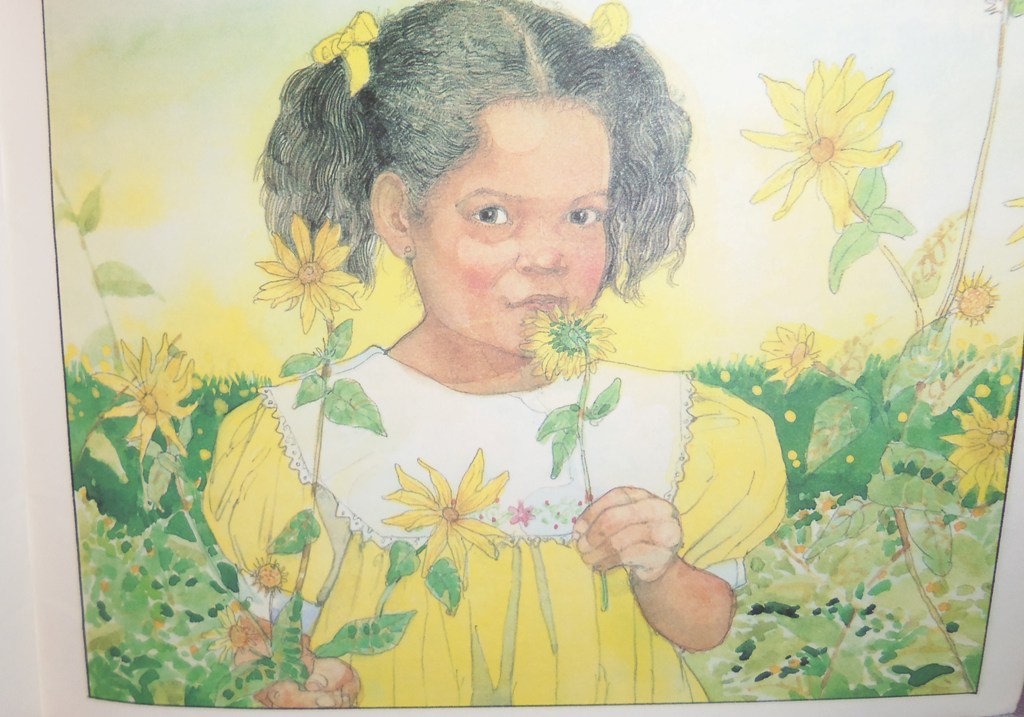
Jerry Pinkney's Anna


Above is another illustration of Pinkney's Anna as she explores a field of beautiful sunflowers.  The feet about the illustration are attached to a doll that looks more like Anna

Super Saucy-type doll by EEGEE, 1961
Up until now I have referred to the above doll as a Super Saucy-type because she uses the same mold as Ideal's 1960s Saucy Walker  (aka Super Saucy).  My doll, however, was made by EEGEE in 1961.*  She stands 29 inches and has been redressed and rewigged.  Her yellow pleated dress is almost identical to Pinkney's illustration of Anna and except for her bangs, their hairstyles are similar.

*(In the past, many doll companies used the same molds, having purchased them from the same manufacturer.  Dolls made by major doll companies were usually more popular than their sister dolls made by smaller companies.  This is the case with my Super Saucy-type.  With Ideal being a more prominent doll company, their Super Saucy was more popular than EEGEE's version.  I am grateful to EEGEE for making a black version because I am not aware of a Super Saucy with dark skin by Ideal.  Until I discover my doll's given name, I guess I'll call her Anna!)

Thank you for the heads up, Dawn, about Anna's book.  As I indicated to you in my email subject line:  "It's always good to learn something new."
 ~~~~~~~~~~

With an original retail of $95, Alice Darling's Let's Play Dolls series can be found on the secondary market today for $25 to $40.  Additional Let's Play Dolls by Alice Darling and other artists commissioned by Madame Alexander can be seen on Flickr where several scanned pages of ads and catalog pages appear.

dbg

Follow my Dolls for Sale blog

Please visit and "Like" The Doll Blogs: When Dolls Speak I Listen

Wednesday, April 11, 2012

Baby Mine or Black Baby Bumps


I immediately recognized this doll as Horsman's Baby Bumps, circa 1910, after seeing it identified for sale as Baby Mine by Ideal.  In spite of the severe head and facial imperfections, I wanted this doll for its historical significance.  A non-stereotypical black doll manufactured by one of America's oldest toy manufacturers during a time when black doll manufacture was usually an afterthought, if a thought at all, is always appealing to me.

The waist of my doll's romper is tagged "Ideal/Baby Mine/Trade Mark," but Baby Mine and Baby Bumps are clearly two different dolls, manufactured some 40 years apart by different companies.

Baby Mine was made by Ideal Toys during the 1950s as an all-composition doll with straight legs.   Black versions of Ideal's1950s Baby Mine are not documented in any of my doll references.  This is not to say that black versions made during the 1950s or prior (using different head sculpts and perhaps a head sculpt like Horsman's Baby Bumps) do not exist.   The doll sold to me as Baby Mine, dressed in Baby Mine's original romper, is either Horsman's Black Baby Bumps (originally named Colored Baby Bumps).  It could be a Baby Bumps lookalike, adding to its historical significance, or Ideal quite possibly made a doll using the same head sculpt*.

Other than their original clothing, which bore the outer waist tag, "Genuine/Baby Bumps/Trade Mark," Baby Bumps dolls were physically unmarked by Horsman.  Without original clothing, Baby Bumps' distinct "art doll" character face, sculpted after Kammer and Reinhardt's No. 100 Baby, aka the Kaiser baby, readily distinguishes it from other dolls.

According to Collector's Guide to Horsman Dolls Identification and Values 1865-1950 by Don Jensen,

In the dog-eat-dog toy industry, successful companies such as Horsman continually were fighting off competition, some of it fair, some of it not so fair, from smaller "copycat" firms.
As early as 1910, the Horsman company published "warnings to the trade" in Playthings magazine. 
One such warning regarding copyright infringement of Horsman's Baby Bumps line of dolls is shown on page 105 of Jensen's book, as illustrated below:

Horsman warns other doll makers of their Baby Bumps trade mark.

200 Years of Dolls: Identification and Price Guide  by Dawn Herlocher, confirms that Horsman manufactured black versions of Baby Bumps in 9-, 10-, 12-, and 18-inch heights.  The 18-inch version is probably the most elusive.

My doll, if an authentic Horsman, is the 12-inch version.  Below are additional images of the doll before I restored him using glue to fill in the cracks and crevices followed by an application of paint and sealer.


With a head made of "Can't  Break 'Em composition," that could "take all kinds of bumps," Horsman's chosen name for their doll, Baby Bumps, seems quite appropriate.  Throughout the past 102 years, however, as evidenced above, this Baby Bumps or a knockoff of the same, has not aged gracefully.

He looks much better now, as illustrated in the images below:

Baby Bumps now

Along with Baby Bumps (or his lookalike) the seller included a circa 1930s glass doll baby bottle, as shown in the background of the above image.

Baby Bumps, restored, is now ready for another 102 years.

Whether or not he is an authentic 1910 Horsman doll or a Baby Bumps lookalike remains a mystery.  There are two things I know for sure:  Baby Bumps is now mine and he looks so-much-better!

To learn more about Horsman's Baby Bumps, read a previous post here.

*Update 11/08/2018
After reading Black Dolls From the Collection of Deborah Neff (Radius Books, 2015) and viewing the scanned image below, I have concluded that my doll quite possibly was made by Ideal and is one of their early 1900s composition dolls named Baby Mine.  In addition to the photo of the doll in Neff's book, someone else shared photos of a doll that is identical to my doll, including the tagged Baby Mine blue and white romper that my doll wears.  Our dolls bear the same marks, shown in the next image of the nape of my doll's neck.

The incised marks on the baby's head appear to be "WAP" or PAW written backward.

It would be too close of a coincidence for two people to have the same circa 1911 doll dressed identically.  Ideal's doll might have been sold wearing other tagged rompers in different colors as documented in this Pinterest pin. Because the photo in Neff's book is in black and white, the color of that doll's romper is unknown; however, the style of it is identical to my doll's romper.

What a lucky little girl to have owned not one but two black dolls.  What I now believe to be Ideal's Baby Mine is the doll on the far left.


dbg

Follow my Dolls for Sale blog