Showing posts with label Debbie Behan Garrett. Show all posts

Thursday, April 28, 2022

Book News


In late February/early March, one of my group members informed me of the doll journals she has created which are sold on Amazon. During our chat, I also discovered that she is a romance novelist. Shea Swain has written several romance novels that are also available on Amazon (through Kindle Direct Publishing) and other sites. Before I share the links to Shea's publications, I want to share some exciting news. 

During my chat with Shea, I asked several questions about Kindle Direct Publishing (KDP) for the possibility of having my third book, The Doll Blogs When Dolls Speak I Listen, reprinted as a paperback. Shea kindly walked me through the process and within a week, I revised my book, updated the back cover, and submitted it to KDP where it is now available to order! 


The Doll Blogs When Dolls Speak I Listen was offered as the first electronic book that features dolls that blog and shortly afterward as an ultra-limited paperback which sold out (as most printed books about Black dolls do) immediately! It has remained as an electronic book on Google Play and in the Kindle store. The ebook version has sold well, but it is the general consensus of most book lovers that they prefer to hold books in their hands. For those readers, The Doll Blogs can now be held (again or for the first time as a paperback or hardcover book as the stories told by each doll about their timeless experiences with their human, me, over a two-year period are enjoyed. 

Book Details

Written for entertainment and pleasure, The Doll Blogs can also encourage junior collectors to appreciate dolls beyond play, and it offers tips on doll documentation.  I hope you will support and enjoy the second-edition printed versions of The Doll Blogs When Dolls Speak I Listen. 

Depending on your browser, on Amazon, the Kindle, the paperback, and hardcover versions of The Doll Blogs might be listed on the same page. You'll have to choose the desired version. 

>Buy the softcover here.
>Buy the hardcover here.

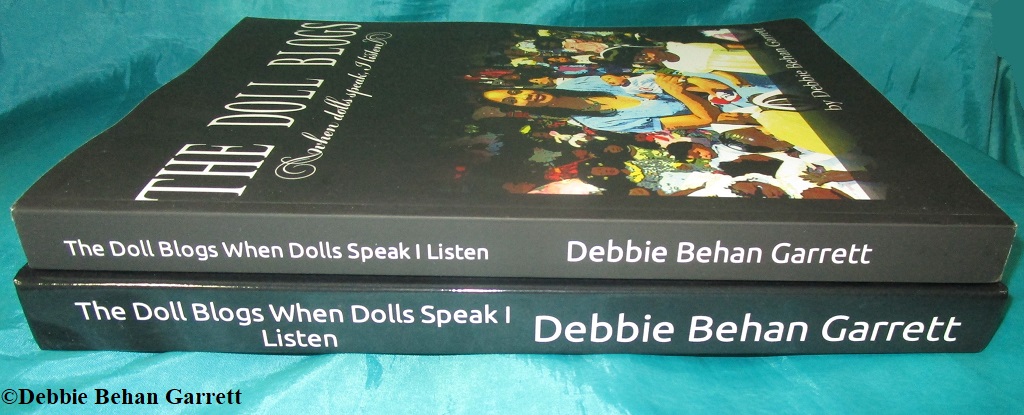
The hardcover and softcover second editions of The Doll Blogs When Dolls Speak I Listen are shown above.


I will have a few hardcover copies to autograph and sell directly. If you would like to purchase an autographed copy directly from me, please send me an email to place your order with your name and mailing address so actual postage can be calculated. 

IMPORTANT: When purchasing the softcover or hardcover books directly from Amazon, check the option, "This order contains a gift." This might ensure that the book is shipped in a box to avoid any cover creases that might occur if the book is shipped in a padded envelope. 

The spines of the softcover and hardcover of The Doll Blogs When Dolls Speak I Listen are illustrated above.


Below are links to Shea Swain's journals, romance novels, and her website. I read and enjoyed Absolve. Please support her, too. Thank you in advance.

Shea Swain's Bias Journals
Shea Swain's Romance Novels
Shea Swain's website


dbg


There are countless items to collect and write about. Black dolls chose me.
__________

Thank you for reading. Comments that are not spam are appreciated. Spam comments will not be published, so don't waste your time. To contact me directly regarding dolls or any of my posts, please use the contact form on the right of the home page, which is visible in "web view." A link to web viewing should be visible at the bottom of this page.

If you're not already a subscriber, visit, "like" and follow the Black Doll Collecting Facebook page or bookmark the Black Doll Collecting home page and visit on Tuesdays and Thursdays when typically new posts are published.

Check out what I am selling here. 
Check out my eBay listings here.
Please follow my sister blog Ebony-Essence of Dolls in Black.
*New*Visit/Follow DeeBeeGee's Virtual Black Doll Museum
Donate here to support this blog. Thank you!

Monday, February 17, 2014

The Doll Griot


Before leaving for Senegal in September 2013, fellow doll enthusiast and educator, Paulette Richards, Ph.D. wrote a glowing and most impressive review of my three books written on the subject of collecting black dolls.   Richards' review, which compares my doll research to the research of two historians of African American history, was too lengthy to post on Amazon.com; therefore, she sent it directly to me.  I posted the review in its entirety on my Facebook Page:  Debbie Behan Garrett, Black Doll Enthusiast a few weeks ago.  Paulette will be a guest blogger later this week.  I thought this would be an opportune time to post the review here.  Thank you again, Paulette, I remain grateful and forever honored.

The Doll Griot
By Paulette Richards, Ph.D.

Debbie Behan Garrett grew up during the era of the Civil Rights movement when African Americans vehemently rejected the stereotypical images of blacks that had long pervaded American mass media. Rather than purchase dolls that perpetuated negative stereotypes of blacks, Garrett’s mother provided only white dolls for her children. Yet young Debbie keenly felt the lack of “dolls that look like me.” In the early 1990s after her own daughter had “outgrown” dolls, Garrett was consumed with a passion for collecting and documenting black dolls. This passion launched her on a trajectory similar to two African American historians of the early twentieth century – Arturo Schomburg, and J.A. Rogers.

“Blacks have no history. There are no black heroes. Black people have accomplished nothing, have contributed nothing to the advancement of human civilization…” Like many students subjected to the routine “miseducation of the Negro,” Arturo Schomburg (1874-1938) heard myths like these when he was a schoolboy in Puerto Rico. Schomburg, however, vowed to prove his teachers wrong. Although he did not follow a traditional academic career like W.E. B. DuBois, he dedicated his life to the study of Afro-Latin and African American history. In 1911 he co-founded the Negro Society for Historical Research. By this time, however, Schomburg had already amassed a large collection of books and artifacts documenting African diasporan culture and history.

Schomburg united scholars from Africa, the West Indies, and the U.S. in the study of African diasporan culture and history. Meanwhile, his collections continued to grow. Although he worked in modestly paid clerical jobs and had five sons to support, the New York Public Library paid $10,000 for his collection of books and materials in 1926. The collection was initially housed in the 135th Street (Harlem) branch of the library and Schomburg was appointed curator of “the Schomburg Collection of Negro Literature and Art.”

Schomburg’s obsessive pursuit of books by and about people of African descent may have seemed crazy to some, but his collection formed the basis of the Arthur Schomburg Center for Research in Black Culture. Similarly, while Garrett’s obsessive acquisition of black dolls may seem irrational to non-doll lovers, her dedication to celebrating the beauty of black dolls echoes Schomburg and Rogers’ determination to destroy myths of racial inferiority.

Garrett published her first book, The Definitive Guide to Collecting Black Dolls with Hobby House Press in 2003. This 176 page soft cover volume catalogues each doll with information on the artist and/ or manufacturer, the material, height, identifying marks, descriptions of the hair/eyes/ mouth, clothing and an estimated value. Then, following in the footsteps of J.A. Rogers, Garrett self-published her second book in 2008.

Joel August Rogers was born in Jamaica in 1880. Although they could not afford to provide much education for their eleven children, Rogers internalized the strong value his parents placed on learning and devoted his life to researching and disseminating as much information as he could about the history of black people. By 1906 he was living in Harlem. Later he took a job as a Pullman porter, which allowed him to comb libraries all over the country. Over the course of his life he also traveled extensively overseas, sifting “the bran of history” as he called it for nuggets of information about the historical experience of black people. Although Rogers was self-educated, self-financed, and self-published, his books eventually earned respect from academic historians. For example W.E.B. Dubois observed that "No man living has revealed so many important facts about the Negro race as has Rogers." Similarly, Garrett’s years of dedicated research and publication have earned her recognition in The New York Times and other prestigious publications as an authority on black dolls. (“The Dolls I Never Had as a Child”)

Like most of Rogers’ works, Garrett’s 450 page volume on Black Dolls: A Comprehensive Guide to Celebrating, Collecting, and Experiencing the Passion is lavishly illustrated. Full color photographs carefully document each doll. Garrett’s collection runs the gamut of materials (bisque, celluloid, composition, rubber, hard plastic, and cloth), aesthetics (artist dolls, craft dolls, manufactured play dolls), and genres such as fashion dolls, paper dolls, and celebrity portrait dolls. Since dolls are usually viewed only as toys for little girls, the “bran” that Garrett sifts might seem even more marginal than the records Schomburg and Rogers searched for evidence about black experience. Further, the bulk of Garrett’s collection consists of manufactured dolls rather than one of a kind dolls and includes play line dolls as well as artist dolls produced in limited editions. Yet, as a record of how the larger society has viewed and represented people of color, her eclectic collection probably has more value than it would if she focused only on art dolls created by black artists as more authentic self-representations.

In traditional West African societies, griots were oral historians who preserved the lineage and noble deeds of their communities. As latter day griots in a time when much of the academic establishment still subscribed to Hegel’s idea that “Africa has no history,” Schomburg and Rogers documented “who we are and where we come from.” Although women rarely served as griots in traditional African societies, in her third book, The Doll Blogs Garrett answers the fundamental questions griots are most concerned with – “Who are your people and where do you come from?” Through her meticulous research into the provenance of each doll, she provides information about the artists who sculpted the dolls, the manufacturers who produced them, the retailers that sold them, and sometimes even includes tidbits about previous owners. Anyone who has done genealogical research would be overjoyed to uncover such detailed information about the African American branches of their family tree for even when there is an oral tradition and/ or paper trail that enables us to trace our ancestors back to the time of slavery, the trail usually goes stone cold on the shores of the Atlantic.

The barracoons that dotted the west coast of Africa from the 16th – 19th centuries transformed human beings into commodities and erased their personal histories. While DNA typing can now take us further into the interior of the Mother Continent and indicate regions where our enslaved ancestors might have come from, it can’t recover the stories of how various individuals met and combined those strands of DNA. The ritual acquisition of black dolls that plays out on every page of The Doll Blogs often occurs through auctions, a scene that is fraught with the painful legacy of slavery and the forced separation of families on the block. Yet Garrett’s purchases are a redemption that gives every black body a voice and a history. Her doll room then functions as a kind of anti-barracoon where lost souls recover their identities and re-unite with family and friends.
***
Paulette Richards has been writing about “the serious business of doll play” on her blog, LimbΓ© Dolls, since April 2011. Formerly the Associate Director of the Nommo Literary Society/ Neo Griot Krewe writing workshop in New Orleans, she holds a Ph.D. in French Civilization from the University of Virginia. During the 2013-2014 academic year, Richards will further explore the griot tradition as a Fulbright Teaching Fellow in Saint Louis, Senegal.


dbg

Follow my Dolls for Sale blog

Please visit and "Like" The Doll Blogs: When Dolls Speak I Listen