Showing posts with label dolls test dolls. Show all posts

Tuesday, September 19, 2023

Black Dolls Exhibition Opening Weekend

Black Dolls exhibit at The Strong National Museum of Play


The Black Dolls exhibit from the collection of Debra Neff that was on display at the New-York Historical Society last year has now traveled to The Strong National Museum of Play in Rochester, NY. It opens at The Strong on September 23, 2023, and will run through January 7, 2024. The image above and the two that follow this paragraph were copied from an email announcement from The Strong.


Additionally, I was asked and agreed to once again loan my black and white versions of Effanbee's 1968 Twinkie dolls for a special exhibit detailing their role (via Drs. Kenneth and Mamie Clark's Dolls Test) in the U.S. Supreme Court's 1954 decision to end school segregation in U.S. Schools. (The Clarks used several dolls from the 1940s through the 1980s; Effanbee's Twinkie dolls are the last known dolls used by the Clarks in their Dolls Test.) My Twinkie dolls had also been on display when the exhibition was at the N-Y Historical Society from February 24, 2022, through June 5, 2022. 

The two Twinkies traveled to New York again on August 22, 2023, where they will remain until the current exhibition at The Strong ends on January 7, 2024.

I captured photo documentation of the dolls' preparation for departure as follows.

The shipping box used to return the Twinkies to me after their N-Y Historical Society exhibition was used for their return trip to New York.

I wrapped each Twinkie in tissue paper.

The tissue-paper-wrapped dolls were placed inside foam cutouts.

Once inside the foam cutouts, I covered each doll with the top of its foam cutout.

I covered the dolls with a top layer of foam.

Next, a styrofoam cover sheet was inserted.

Placing the box top on the shipper and taping it in place was the last thing I did before the dolls were picked up. I did not photograph the box with the top in place.

After the dolls were on the delivery truck, the transporters remained in the truck cab for several minutes before driving off. Attempting to be inconspicuous, I peeked through the front window the entire time recording the truck as it sat and as it departed. 


Am I an overprotective documentation geek when it comes to my dolls? You bet I am!

Related Link


©Black Doll Collecting/dbg

There are countless items to collect and write about. Black dolls chose me.

__________

Thank you for reading. Comments that are not spam are appreciated. Spam comments will not be published, so don't waste your time. To contact me directly regarding dolls or any of my posts, please use the contact form on the right of the home page, which is visible in "web view." A link to web viewing should be visible at the bottom of this page.

If you're not already a subscriber, visit, "like" and follow the Black Doll Collecting Facebook page or bookmark the Black Doll Collecting home page and visit on Tuesdays and Thursdays when typically new posts are published.

Check out what I am selling here. 
Check out my eBay listings here.
Please follow my sister blog Ebony-Essence of Dolls in Black.
*New*Visit/Follow DeeBeeGee's Virtual Black Doll Museum
Donate here to support this blog. Thank you!

Tuesday, March 1, 2022

Dolls' Travel Preparation and Arrival

Black and White vinyl 16-inch versions of Twinkie by Effanbee


As mentioned in the post about the New-York Historical Society's Black Dolls exhibition, two of my dolls (black and white versions of Effanbee's 1968 Twinkie) are on loan to the museum. 

In October 2020, I received an email request from Dominique Jean-Louis, Associate Curator for History Exhibitions at the New-York Historical Society. Ms. Jean-Louis wrote:

I saw your post about obtaining a pair of white and black Effanbee dolls, similar to those used by Drs. Kenneth and Mamie Clark, in their famous doll test experiments- congratulations! We plan on sharing their story in our exhibition, and I wanted to reach out about the possibility of a loan of your dolls. It would be so powerful to have the dolls as a visual for our visitors!
I agreed to loan the two Twinkies. A few months later, I signed the loan release forms after which, art handlers were scheduled and arrived to pick up the dolls on December 28, 2021. I asked if I could take photos as the three handlers performed their designated duties. One handler packed the dolls, a second prepared the paperwork for me to sign, and a third (a new hire) observed the process.

An art handler used a knife to cut out a space for each doll to fit inside the foam packing of the shipping box.

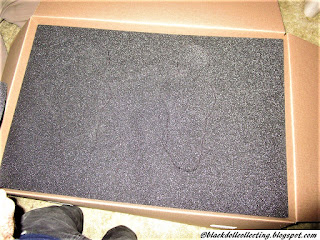
The main handler traced each doll from head-to-toe onto black foam that filled an oversized shipping box. The above picture illustrates him cutting out the tracing for the first doll. 

A cutout for each doll has been created. In this photo, the handler holds one of the cutout pieces that later serves as a protective cover after the doll is inside the foam.
 

One doll is securely inside the foam bed.

This photo of the first Twinkie was taken from another angle.

The second doll is positioned securely inside its foam bed.

Both dolls are inside their foam beds and the cutout pieces are placed on top of each.

After the dolls were placed inside the foam, the third, newly-hired handler said, "I don't mean to sound morbid, but they look like they are in coffins." Admittedly, I was as amazed while I watched the main handler gently manipulate the dolls, create the cushioned shipping beds and toppers for each, and finally secure them in the shipping carton.

Before they left, I thanked them for their expertise and wished the third guy luck with his continued on-the-job training as an art handler.

They Made It!

My Twinkies are currently on display at the New-York Historical Society. 

Doll-friend Romona Jennings attended the grand opening ceremony of the Black Dolls Exhibition on the evening of February 24, 2022, and returned to enjoy it on February 26, 2022. She took the above photo of the dolls and the object identifier, which is shown in a close-up photo below.

A picture illustrating a child participating in Drs. Kenneth and Mamie Clark's Dolls Test,  seen here, taken by Gordon Parks in 1947, is on the wall above my Twinkie Dolls. The object identifier begins with the description of that photo followed by the description of the dolls.

Object Identifier (click or stretch to enlarge.)


The dolls are described on the object identifier as follows:
Effanbee Toy Company
Twinkie Dolls, ca 1968
Vinyl, textile
Private collection of Debbie Garrett

The last three paragraphs of the object identifier describe how the dolls were used in the 1954 Supreme Court decision that ruled segregated schools unconstitutional in the U.S. 
 
The Black Dolls exhibition at the New-York Historical Society runs through June 5, 2022.  My two versions of Effanbee's 1968 Twinkie dolls—the last known type of dolls used by the Clarks in their Dolls Tests—will be returned to me after the exhibition concludes. I hope their story along with the stories of the other dolls in the exhibition will receive a warm reception.

Bonus 1

At this link, view a video filmed at the exhibition by one of my Facebook friends.

Bonus 2
At this link, listen to an In The Doll World podcast interview of Dominique Jean-Louis. The assistant curator of this exhibition speaks in-depth about the Black Dolls exhibition and other events planned by the New-York Historical Society.

dbg


There are countless items to collect and write about. Black dolls chose me.
__________

Thank you for reading. Comments that are not spam are appreciated. Spam comments will not be published, so don't waste your time. To contact me directly regarding dolls or any of my posts, please use the contact form on the right of the home page, which is visible in "web view." A link to web viewing should be visible at the bottom of this page.

If you're not already a subscriber, visit, "like" and follow the Black Doll Collecting Facebook page or bookmark the Black Doll Collecting home page and visit on Tuesdays and Thursdays when typically new posts are published.

Check out what I am selling here. 
Check out my eBay listings here.
Please follow my sister blog Ebony-Essence of Dolls in Black.
*New*Visit/Follow DeeBeeGee's Virtual Black Doll Museum
Donate here to support this blog. Thank you!

Monday, February 10, 2020

Last Known Dolls Test Dolls


Black and White versions of Effanbee's 1968 Twinkie are on display at the National Museum of  African American History and Culture in Washington, D.C.

My quest to find dolls like the last known dolls used in Drs. Kenneth and Mamie Clark's Dolls Test began in late 2018.  It was around that time that I first saw the above online images of the dolls, which are now on display at the National Museum of African American History and Culture.  The site only identifies them as being made by Effanbee in 1968.  Because I knew the Clarks began conducting their Dolls Test during the late 1940s to study the psychological effects of segregation on African American children, I surmised that these were one of the last pair of dolls used in the test and in their psychology practice at the Northside Center for Child Development in Harlem New York.

According to Dr. Kenneth Clark's eulogy, the first dolls used in the Dolls Test were purchased from Woolworth's on 125th Street in Harlem for 50 cents.  They were probably made of composition.  The last known dolls the doctors used, made by Effanbee, are made of vinyl.


Snowball (a.k.a.) Black Grumpy by Effanbee 1913
The Effanbee doll company began making dolls during the early 1900s and was always an inclusive doll line.  Their Black dolls date back to their inception in 1912 with Snowball (also known as Black Grumpy) being offered in 1913.  Snowball is a 12-inch composition doll that has a cloth body, upper arms, and legs.

Because Effanbee has made a variety of dolls throughout the years, with many having similar facial features and/or using the same head sculpts, some offered optionally as White or Black, and some issued only in White versions, I had to first determine which 1968 Effanbee doll made in both Black and White versions was the last doll used by the  Clarks in their doll study.  The doll was eventually identified as Twinkie as noted in the first image of this post.  The details of my research are included in my blog post, Twinkie or My Fair Baby?  A link to the post is included under the Related Links section of this post.

With the actual doll and the 16-inch size identified, I searched for and saved several different search combinations on eBay.  Doing this would prompt eBay to notify me when there were new listings that contained keywords from my saved searches.  Some of the saved searches included "black doll Effanbee"; "1968 doll Effanbee"; "1968 black doll"; and "Effanbee Twinkie" to name a few.


16-inch Twinkie from 1968 by Effanbee

I knew it would be easier to find the White version first and that is what happened.  In April 2019, this 16-inch all-vinyl doll arrived wearing a hand-knit dress, bonnet, diaper, and booties as illustrated above.  The doll's head marks are as shown below:

14
EFFANBEE
19©68
2500

Her back is marked:
EFFANBEE
19©68
2808

The search continued for her counterpart.


At 15-inches tall, this Twinkie is an inch shorter than the 1968 version and the head sculpt is slightly different.  The nape of her neck is marked:  EFFANBEE ©1959.  Her back is marked EFFANBEE 19©64, which means she was released by the company in 1964 but uses the 1959 Twinkie head mold.  She arrived (with the doll shown next) wearing an untagged red flannel romper.  


An 11-inch version of Vogue's Baby Dear was offered with 1964 Twinkie.

Black Twinkie from 1964 arrived in August 2019.  Even though this version was not made in the same year and is not the same height as the 1968 Dolls Test dolls, I purchased 1964 Twinkie because of the very low beginning bid.  Because I was still playing with dolls in 1964, this version of Twinkie and the doll that traveled with her (Vogue's Baby Dear) are dolls I could have owned as a child had they been available for my mother to purchase.  For nostalgic reasons, I bid and won the auction as the only bidder.  The search for the 1968 Black version continued.


1968 Black Twinkie was finally found wearing a brown floral-print dress with matching bonnet.  Her head and back markings are identical to the White doll's marks.

In October of 2019, the long-sought-after 16-inch Black version of Effanbee's Twinkie from 1968 was offered in an auction at an incredibly low price.  I had a bidding competitor or two who also wanted the doll, but I was the determined high bidder winning the auction at still a very low price.  That win, of course, was followed by a long sigh of relief.


The 1968 Twinkie dolls wear their arrival clothing.

With both dolls having been found, the next step was to remove and store their clothing and dress them in white diapers as the Clarks had done with their dolls.  An unused pre-folded cloth diaper was used to make two doll-size diapers.

I used the White doll's knit diaper as a pattern to cut out two diapers that would fit the dolls.   The cut edges were stitched to prevent fraying.  I also used clear nail polish on the cut edges for reinforcement.  The diapers are pinned on with medium-size safety pins as shown next.


16-inch all-vinyl Black and White versions of Effanbee's 1968 Twinkie
With this mission accomplished, I am now the proud owner of dolls like the last ones Drs. Kenneth and Mamie Clark used in their Racial Identification and Preference in Negro Children study which commenced during the late 1940s. This study used dolls that were identical except for gender and race to prove that racial segregation caused Black children to feel inferior to White children.

One of the Clarks' first experiments using dolls involved 253 African American boys and girls ages three to seven, who resided in northern and southern regions of the United States.  The children had brown complexions that varied from light, medium, to dark.  They were instructed by the experimenter to do as shown in the image below.


Results showed the majority of children chose the White doll when performing requests 1, 2, and 4.  The majority chose the Black doll for request 3 (give me the doll that looks bad).   Test results proved that African American children felt racially inferior to White children.

The Clarks went on to become expert witnesses in several school desegregation cases where their Dolls Test, as it was later dubbed, was used in the Supreme Court case Brown v. Board of Education of Topeka, Kansas to prove racial segregation resulted in inferiority complexes in Black children.  That case ended in the landmark decision in 1954 that racially segregated public schools were unconstitutional.   Formerly segregated public schools throughout the U. S. were required to desegregate and were given 20 years to do so.  Some states, Texas being one, did not complete the desegregation process until the deadline year approached.  I am a product of that school desegregation mandate, spending my junior and senior years of high school being bussed to and from a predominantly White school located outside my immediate neighborhood.

The Clarks continued their studies on racial bias at their Harlem center through the 1970s by which time all U. S. public schools had been desegregated.   Of note, Dr. Kenneth and Mamie Clark became the first and second African Americans to graduate with a Ph.D. in Psychology from Columbia University.  Dr. Kenneth Clark graduated first.  Also of note, in 1966, Dr. Kenneth Clark became the first African American president of the American Psychology Association.

In this last photo, Effanbee's 15-inch Twinkie from 1964 poses with the 16-inch versions from 1968.


Related Links
Dr. Kenneth Clark's Eulogy
Twinkie or My Fair Baby
Doll Study 1947 Racial Identification and Preference
Video: Brown v. Board of Education Doll Test
Video: Dr. Kenneth Clark speaks in a 1988 interview

dbg


There are countless items to collect and write about. Black dolls chose me.
__________

Thank you for following, commenting, and sharing using the share button below.

Check out what I am selling here. 
Check out my eBay listings here.
Please follow my sister blog Ebony-Essence of Dolls in Black.
Donate here to support this blog. Thank you!

Friday, February 22, 2019

Twinkie or My Fair Baby?

Circa 1960s Twinkie by Effanbee looks similar to the Dolls Test dolls currently on display in the National Museum of African American History and Culture.  The museum has one white doll and one black doll, dressed in diapers only.  Photo of a photo in Effanbee a Collector's Encyclopedia 1949-Present

Twinkie
After viewing online pictures of the "Dolls Test" dolls on display at the Smithsonian National Museum of African American History and Culture (NMAAHC), I wanted to know more about the dolls other than their copyright year and the manufacturer's name, 1968 and Effanbee, respectively.  The museum label indicates "these and other dolls" were used in the Dolls Test.  They were donated to the museum by the Clark's daughter.  The 1968-marked dolls were used many years after the first 1940s Dolls Test dolls.  The first dolls used were purchased from a Harlem Woolworths for 50 cents.

Links to the museum's black doll and white doll were sent to the Facebook group Let's ID Our Dolls with a request for help with the doll's name.  One member replied, identifying the dolls as Effanbee's Twinkie.

Using Google, I found this image of a black Effanbee doll labeled as Twinkie from 1968.  The doll's widow's peak looks similar to that of the dolls in the museum.  This Pinterest image of a nude black doll is also described as Effanbee's Twinkie.  Its description indicates the doll has its original hang tag.  Effanbee's hang tags usually bear the doll's name.  However, hang tag images were not shown for either of the above two dolls.  In this completed eBay auction, this black doll has a hang tag that reads "Twinkie."  The doll was described as being from the 1980s but nothing else regarding the doll's marks was included in the description.  The "circa 1980s" timeframe could have been a seller error.  These three dolls look like the dolls in the NMAAHC.

I shared this information with another doll enthusiast whose series of questions led to further research.

I had already referenced John Axe's book, Effanbee a Collector's Encyclopedia 1949-Present, which was published by my first publisher, Hobby House Press, Inc., in 1994.  Axe's book shows that Twinkie was in Effanbee catalogs for the years, 1959-1967; 1970-1983, and 1984-1986.  Note that 1968 is not included.

From the index of Axe's book, the parenthetical dates indicate the years in which Twinkie was made.  This is followed by the various page numbers in the book which contain either catalog text and/or images of Twinkie.  The book includes very few images of Twinkie and none were of the black doll.
Based on the from-to dates, it is safe to assume that the 1959-1967 dolls used the same head sculpt and that the head sculpt was changed in 1970 and changed again in 1984.

Referring to the pages in the book (illustrated above) on which these catalogs appear, none of the Twinkie dolls are listed as having been "Negro," which is the racial identity term Effanbee used in their catalogs for these years with an "N" placed behind the dolls' stock number and "Negro" spelled out in the associated description.

Why is the "Negro" version of Twinkie not listed in any of Effanbee's catalogs in Axe's book and why is Twinkie not listed in black or white versions in the 1968 catalog in the book?  Did Axe not include some catalog information in his book, or were the dolls manufactured after the catalogs were published?

My Fair Baby

Effanbee's My Fair Baby from 1968 is shown in a screen-captured photograph.

A Google search for "1968 Effanbee Doll" led me to a Ruby-Lane-sold doll by Effanbee named My Fair Baby.  Since the link to Ruby Lane's actual buy page no longer exists, the doll is shown in a screen capture above. This doll also looks like the museum dolls.


From the index of Axe's book, the parenthetical dates indicate the 10-year span in which My Fair Baby was made.  This is followed by the page numbers in the book which contain catalog text.  There is only one image of the 1960s rooted-hair version of My Fair Baby in the book and that doll has blonde hair.  There are no images of a black My Fair Baby in the book.
According to Axe's book, My Fair Baby was on the market from 1958-1968.  Voila! (I think.)  The last year of manufacture matches the year the museum indicates as the year their donated dolls were manufactured.  The 1968 catalog in Axe's book also lists a 14-inch black version of the doll with molded hair and with rooted hair as indicated by the "N" that follows the stock number in the next image.


Shown in the above scan from Effanbee's 1968 catalog in Axe's book, My Fair Baby was available as a black doll (4461N and 4481N) with molded and rooted hair, respectively.  Like these versions of My Fair Baby, Effanbee dressed all My Fair Baby and Twinkie dolls from prior and subsequent years in baby-style clothing.  Unlike the museum's donated dolls, none of these dolls were released wearing a diaper only.

To make the dolls' gender ambiguous, I believe the Clark's replaced the dolls' original clothing and created diapers using cotton waffle-weave cloth; or, the donated dolls were nude and the museum added the cloth diapers.


Summary


Side-by-side pictures of the black doll donated to the NMAAHC and the Ruby Lane doll sold as My Fair Baby

I am not positively certain which doll was donated to the museum but based on the year, 1968, it seems plausible that the dolls are black and white versions of Effanbee's 1968 My Fair Baby dressed in replaced diapers.

As a side note, since 1960s-1980s Twinkie appears to share the same sculpt as My Fair Baby.  Could it be that the name, My Fair Baby, was discontinued after 1968 and the mold continued in use for Twinkie?   This would explain the reason for the eBay auction for a black circa 1980s Twinkie that looks like the 1960s doll.  The fact that Axe's book does not document black versions of Twinkie could be an oversight on the author's part and/or Effanbee's failure to include the doll in their catalogs.  Human error is always a possibility.

Related Post:
Simple Justice and see the links at the end of the Simple Justice post.


dbg
There is always something to collect and write about. Black dolls chose me.
__________

Thank you for following, commenting, and sharing using the share button below.

Check out what I am selling here. 
Check out my eBay listings here.
Please follow my sister blog Ebony-Essence of Dolls in Black.
Donate here to support this blog. Thank you!